



What size mini split a North Dakota home needs

Send the form and the search for an installer is over.

Let a pro reach out

Sizing depends on your home's square footage and how well it holds heat, not a flat number that works for every house. A one ton mini split covers roughly 300 to 450 square feet with good insulation, and most North Dakota homes need more capacity than that same house would in a milder state, because the unit also has to carry the load on the coldest days of winter. Undersized units run constantly and still fall short when it drops below zero. Oversized units cycle on and off too fast, which wears parts and leaves rooms uneven. A contractor sizes it with a load calculation that accounts for your square footage, window area, insulation, and the design temperature for your area, not a chart that assumes an average house. Most homes end up needing a two to three ton system for a whole main living space, sometimes split across multiple zones. Getting this number right before installation matters more here than almost anywhere else, since a mismatched system either can't keep up or wastes power trying.

A white wall-mounted mini-split air conditioner unit near the ceiling on a plain light-colored interior wall with open space to the right.

Why insulation changes the number

A mini split sized by square footage alone can still leave a room short. Heat loss through walls, windows and the ceiling is what the unit actually fights against, not the floor space itself. An older home with single pane windows loses heat faster than one built with current code insulation, so two houses of the same size can need different capacity. A contractor who sizes the unit will look at your walls and windows, not just a tape measure.

A white wall-mounted mini-split air conditioner unit installed near the ceiling on a plain beige interior wall, with a light curtain at the right edge.

What oversizing actually costs you

A mini split too big for the room cools or heats it fast, then shuts off before it pulls moisture out of the air or settles into a steady temperature. That cycling wears on the compressor over time and leaves the room feeling clammy in summer despite the thermostat reading right. Undersized is its own problem, running flat out on the coldest days and never quite catching up. The right size runs longer at lower output, which is where these units work best.

How does a contractor actually figure out what size mini split to install?

You want to know what actually happens before a number gets picked, not just that it's based on square footage. You've read that insulation matters too, but you're wondering what a contractor does with that information. Is there a formula, a walkthrough, something they measure, or is it more of an educated guess based on experience with homes like yours?

A room by room load calculation, not a single number for the whole house

A contractor measures each room the mini split will serve and runs a load calculation called a Manual J. It accounts for square footage, ceiling height, window size and direction, and how many exterior walls are exposed to a North Dakota winter. A north facing bedroom with two outside walls loses heat differently than a south facing living room, even if both rooms are the same size. The calculation also factors in how the space is used: a kitchen with appliances running gives off heat a bedroom doesn't. The result is a BTU number specific to that room, not a rule of thumb. That number is what decides whether a single zone or a multi zone system makes sense for your layout.

A white wall-mounted mini-split indoor unit installed high on a gray interior wall, with a sofa, dark table and window visible in an adjoining room to the right.

Sized right, it runs quiet in the background

A mini split that matches the room holds its temperature without straining. The compressor cycles on, does its work, and shuts off. You won't hear it laboring, and the air coming off the unit stays steady.


A wall-mounted mini-split air conditioner indoor unit with a dusty beige casing and dark louvered vent, installed near the ceiling on a plain beige wall.

Undersized or aging, it shows on the case

Dust and yellowing on the housing often mean the unit has been running long stretches to keep up. A mini split that's too small for the space rarely shuts off, and that strain shows up on the equipment before it shows up on your bill.

Why does one room never feel right?

You've probably got a room that won't cooperate. The unit runs and runs in January and the air coming off it feels lukewarm by the time it reaches the far wall. Or it's July, the room gets muggy fast, and the mini split shuts off again before it's actually caught up. Undersized, it never stops working, and your power bill moves even though cheap power here means you don't expect that. Oversized for a small room, it short cycles, turning on and off instead of running steady, and the air feels damp instead of dry in summer. Either way, you notice it in that one room before you notice it anywhere else in the house.

A man in a blue sweatshirt reclines with closed eyes in a brown leather armchair in a living room with a bookshelf, houseplant, sofa, window, and a side table holding newspapers and a dark mug.
A bearded man in a gray pullover reclines with closed eyes on a brown leather sofa in a sunlit room with a window, framed picture, potted plant, and a wooden cabinet holding papers and a dark mug.
A man in a gray sweater leans back with closed eyes in a brown leather armchair beside a wooden side table holding a dark mug and a folded newspaper, with bookshelves and a window seat behind him.
A man in a green sweater reclines in an armchair with his eyes closed and a slight smile, beside a window with plants, a small table holding a mug and folded newspaper, and bookshelves behind him.
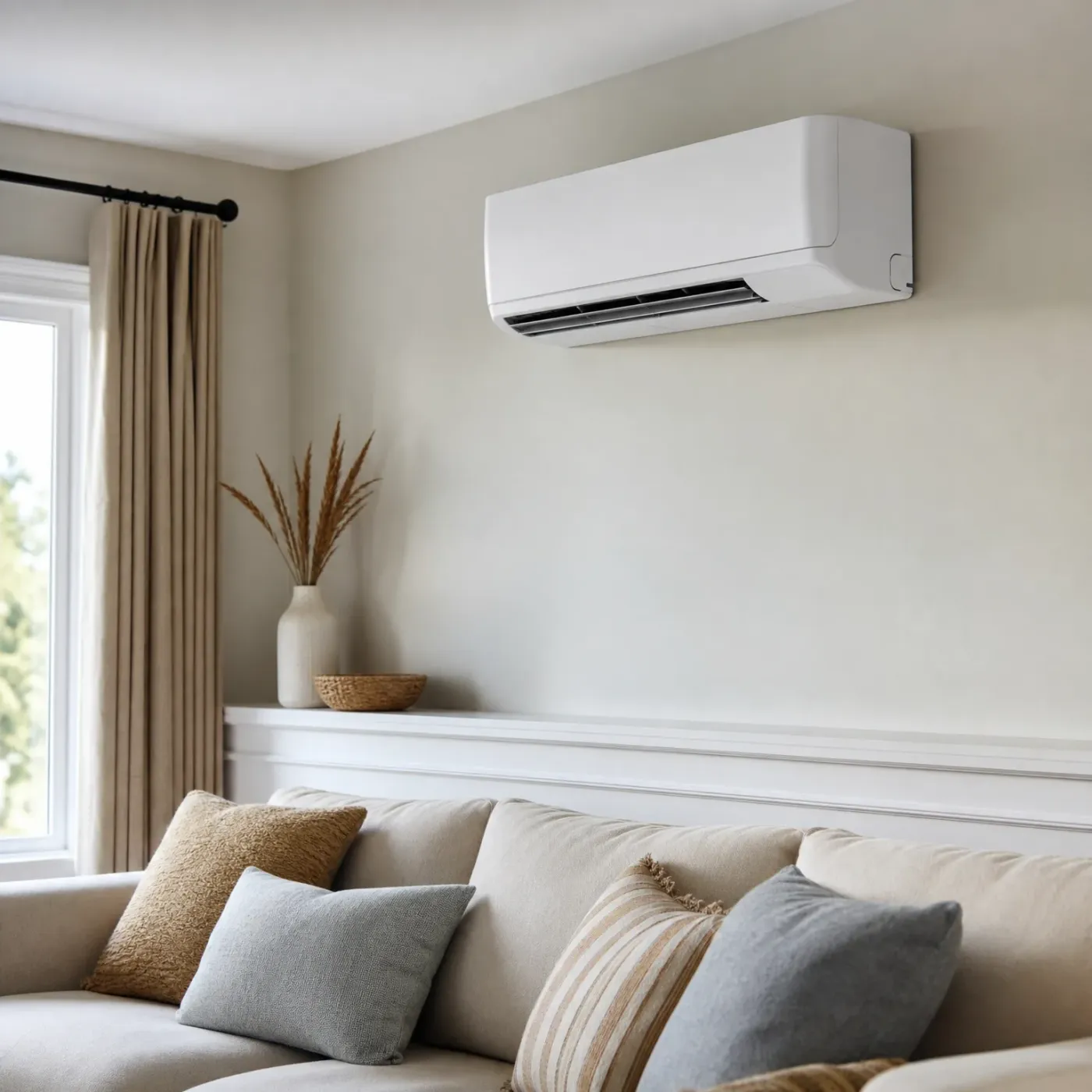
A white wall-mounted mini-split air conditioner on a pale wall above a beige sofa with assorted cushions, beside a window with long curtains and a shelf holding a vase of dried grasses and a woven bowl.

Let someone else find the pro

Your request goes to one pro, not a list of companies.

Send the request and finding a pro stops being your problem.

I'm done searching

You're not committing to anything by asking.

A white wall-mounted mini-split air conditioner unit high on a light gray interior wall, with a beige curtain and window at the left and wood-look flooring below.
A mini split sized to the room cycles on, runs its course, and shuts off, keeping the space steady without strain.
A dusty white wall-mounted mini-split air conditioner indoor unit with open louvers, installed near the ceiling on a plain light-colored wall.
An undersized unit never gets a break. It runs nonstop trying to catch up, and dust and grime build up fast on a coil that's always working.

One Zone or Several: Sizing the Right Setup

One zone

  • A single indoor unit heats and cools one room or an open living area well, but it won't reach a closed-off bedroom down the hall.
  • Install is simpler, with one line set running from the outdoor unit to one spot on the wall.
  • Works well if you're supplementing a gas furnace and just want relief in the one room that never feels right.
  • Lower upfront equipment cost than a multi-zone system, since you're only paying for one indoor head.
  • If you later want to cover a second room, you'll need a separate system or a different outdoor unit sized for multiple zones.

Multi-zone

  • One outdoor unit runs two or more indoor heads, so you can cover a bedroom and a living room off the same system.
  • Each zone has its own thermostat, so a room that runs cold in January doesn't force the whole house to overheat to compensate.
  • The outdoor unit has to be sized for the combined load of every zone, not just the biggest room.
  • Line sets run to each indoor head separately, so the install takes longer and involves more wall penetrations.
  • Good fit if you're trying to get a whole floor, or several rooms that fight your furnace, onto one consistent system.
A white wall-mounted mini-split air conditioner installed near the ceiling on a plain beige interior wall.

Running the right size

A mini split sized to the room holds its temperature on its own. The compressor shuts off when the space is cool, then starts again later. The casing stays clean because the unit isn't fighting a losing battle all day. You'd walk past it and not think twice.

A dusty, discolored wall-mounted mini-split air conditioner unit near the ceiling of a plain beige interior wall.

A unit that's been overworked

Dust and grime build up fast on a casing that never gets a break. If the unit is undersized or the coil hasn't been cleaned, it runs long cycles trying to catch up and wears faster for it. Discoloring like this is a sign of age, but also of strain.

Power costs 11.82 cents per kilowatt-hour statewide

At 11.82 cents a kilowatt-hour, running an oversized mini split on heat strip backup or straining a undersized one through a cold snap shows up on the bill fast. Getting the size right the first time is what keeps it cheap to run.

EIA-861 2025 statewide residential average

You size for the room you're heating and cooling, not the whole house. A mini split in the living room has to cover that open space alone, which usually runs larger than a bedroom and takes more capacity to hold steady.

A bedroom with a door that stays shut needs less. Once that door closes, the unit is only fighting heat loss through one set of walls and a window or two, so a smaller size holds it fine through a North Dakota winter.

A wall-mounted mini-split air conditioner indoor unit with a discolored cream plastic casing and dusty outlet vanes, installed high on a plain light-colored interior wall near the ceiling.
Before you get your mini split installation
A white wall-mounted mini-split air conditioner installed high on a beige interior wall near the ceiling molding, with a light curtain and curtain rod at the left edge.
After you get your mini split installation
A two-story gray horizontal-siding house with multiple gables, a covered front porch with white columns and railing, and a dark front door, fronted by a patchy green and brown lawn under a clear blue sky.

Summer air in North Dakota sits at a dew point of 53°F, averaged across June, July and August by NOAA. That's dry air. Your mini split isn't fighting the moisture a Gulf Coast or Midwest unit fights, so it spends less time pulling humidity out of the room and more time just dropping the temperature. A properly sized unit will cool fast and shut off, rather than running long cycles to wring water out of the air. If yours feels right in square footage but still runs longer than it should, humidity isn't the reason. Look at the insulation and the room size instead.

NASA POWER T2MDEW county cells weighted by homes

An older man with gray hair and a beard leans back on a beige sofa with his eyes closed, in a sunlit room with potted plants, a wicker chair and large windows behind him.
A woman in a cream knit sweater sits in an armchair with her eyes closed and a slight smile, beside an open window showing orange autumn foliage, with a mug, books and a lit candle on a small side table.

Getting the size right

  • The right size comes from square footage, insulation and how closed off the room is, not a single rule of thumb.
  • A unit sized to the room cycles on and off instead of running flat out all day.
  • Dry summer air here means the mini split spends less time wringing out moisture than one on the Gulf Coast.
  • A local contractor who installs these year-round has seen which rooms in homes like yours run short and why.
  • One contractor takes the call, so you're working with someone who already knows the equipment instead of fielding several bids.
  • Once the sizing is right, the rest of the install is routine work for someone who does it every season.

Square footage starts the number, but insulation and how closed off the room is finish it. A one ton unit might cover 450 square feet in a well insulated bedroom and fall short in a drafty living room half that size. That's the math a contractor works through before anything gets installed.

Get it right and the mini split barely announces itself. The compressor runs, the room settles, and it shuts off until it's needed again. Get it wrong and you've got a unit running nonstop through a North Dakota winter, or one short-cycling so much it never pulls the moisture out of the air in July. Either way shows up on the power bill, even with rates as low as they are here.

Winter is the harder test in this state, since most homes lean on gas and the mini split is picking up specific rooms rather than the whole load. Summer asks less of it, since the air here doesn't carry the humidity a unit on the Gulf Coast has to fight.

A contractor who installs these every season in North Dakota has already seen which rooms run short and why, whether it's a bonus room over a garage or a bedroom at the end of a long duct run. That's the kind of problem solved faster by someone local than by someone guessing from a square footage chart. And it's one contractor on the job, not three competing for the work, which means the person on the phone already knows the equipment before they ask about your house.

At dusk, a dark board-and-batten house with a standing-seam metal roof and lit entry walkway of stone pavers, with two large outdoor heat pump units on a stone-walled pad at right and trees and hills in the background.

Mini Split Installation

One request and it's handed off

Step 1 of 3: Equipment
  • A brown leather and wood armchair with a cream knit throw sits in a corner beside a woven basket holding a dark cushion, under a framed mountain photograph, with a wood-trimmed window showing yellow and green foliage.
    • A local installer who puts in mini splits gets your project.
    • Get in touch with a local installer about a new mini split.
  • A dark wood dresser against a pale wall holds a ceramic vase of eucalyptus branches, a stack of books with a wooden bowl, and a woven basket, with a framed landscape painting above and a woven basket holding a knit blanket on the floor beside a window.
    • One request and the search for a pro is handled.
    • Send it once and finding someone is no longer on you.
  • A window seat with beige linen and brown textured cushions, a chunky knit blanket, and an open book, beside a window showing blurred yellow autumn foliage.
    • Skip the round of in-home estimates for a new mini split.
    • Describe the project once instead of to every installer.
  • A cream upholstered armchair with a rust-colored pillow and knit fringed throw sits beside a window with a ceramic vase of orange-leafed branches on the sill, overlooking autumn trees and leaf-covered ground.
    • The pro who reaches out is licensed in North Dakota.
    • Only one pro gets your request, so you hear from one company.